
GitOps vs DevOps: Understanding the Differences, Benefits, and When to Use Each
2/2/2026
In today's fast-paced software delivery landscape, engineering teams are under constant pressure to ship faster, scale reliably, and maintain high standards of security and compliance. DevOps transformed how development and operations collaborate, but as systems have become more cloud-native and distributed, a newer approach has gained significant momentum: GitOps.
This raises an important question for modern engineering teams and organizations:
Is GitOps better than Traditional DevOps, or does Traditional DevOps still hold its ground?
This blog offers a deep, practical, and unbiased comparison of GitOps and Traditional DevOps, covering workflows, benefits, limitations, team impact, tooling, security, scalability, and real-world use cases. By the end, you'll have clarity on which approach works better for modern teams—and how to choose the right one.
Understanding Traditional DevOps
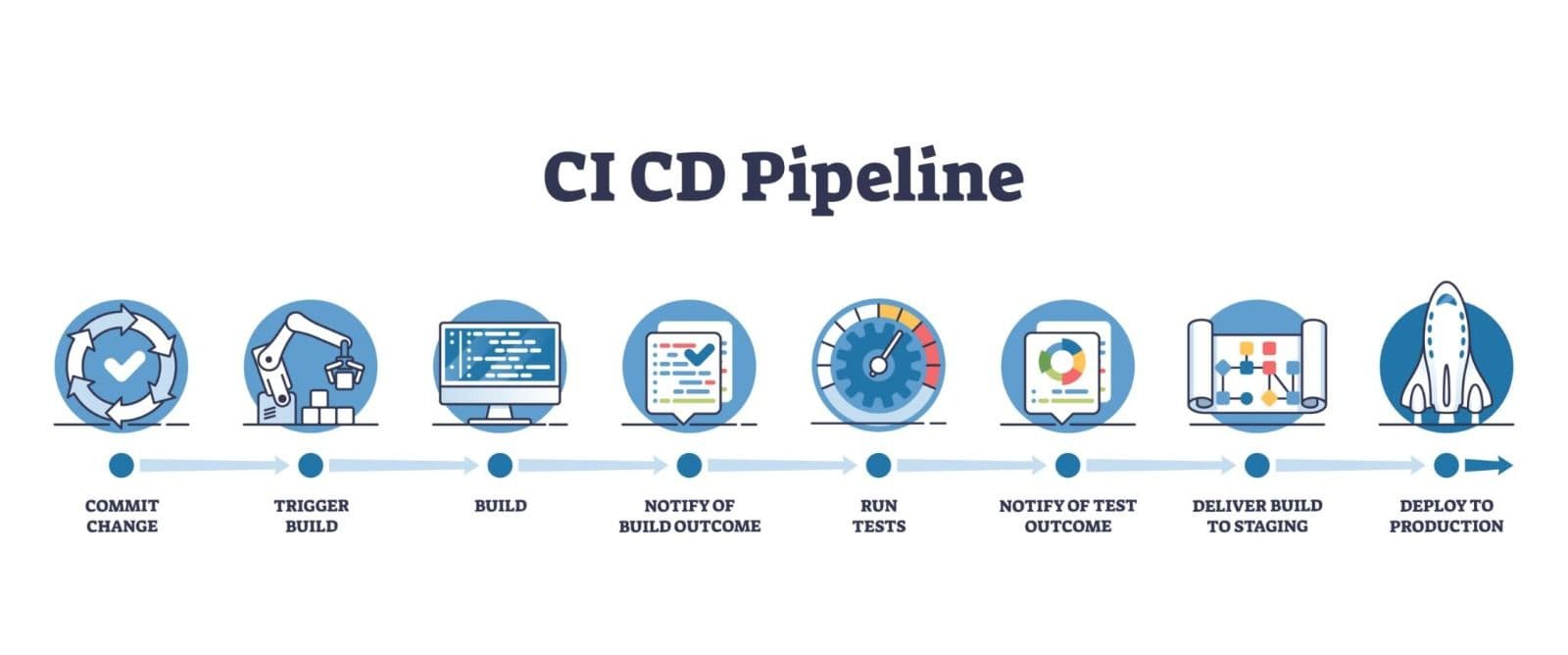
Traditional DevOps is both a cultural philosophy and a technical practice aimed at breaking down silos between development and operations teams. Its core objective is to enable faster, more reliable software delivery through collaboration, automation, and continuous feedback.
In a traditional DevOps setup, teams rely heavily on CI/CD pipelines. Developers push code to repositories, which triggers automated pipelines that build, test, and deploy applications. Infrastructure is often managed using Infrastructure as Code tools, but execution is typically imperative—scripts and pipelines explicitly instruct systems on what actions to take.
Key characteristics of Traditional DevOps
- CI/CD pipelines act as the central control mechanism
- Deployments are usually push-based
- Infrastructure changes may happen through scripts, pipelines, or manual interventions
- Supports a wide range of environments including VMs, on-premise systems, cloud platforms, and legacy infrastructure
- Highly flexible and tool-agnostic
Traditional DevOps has powered countless successful engineering teams and continues to be widely used across enterprises. However, as environments grow more complex, certain challenges become evident.
What Is GitOps?
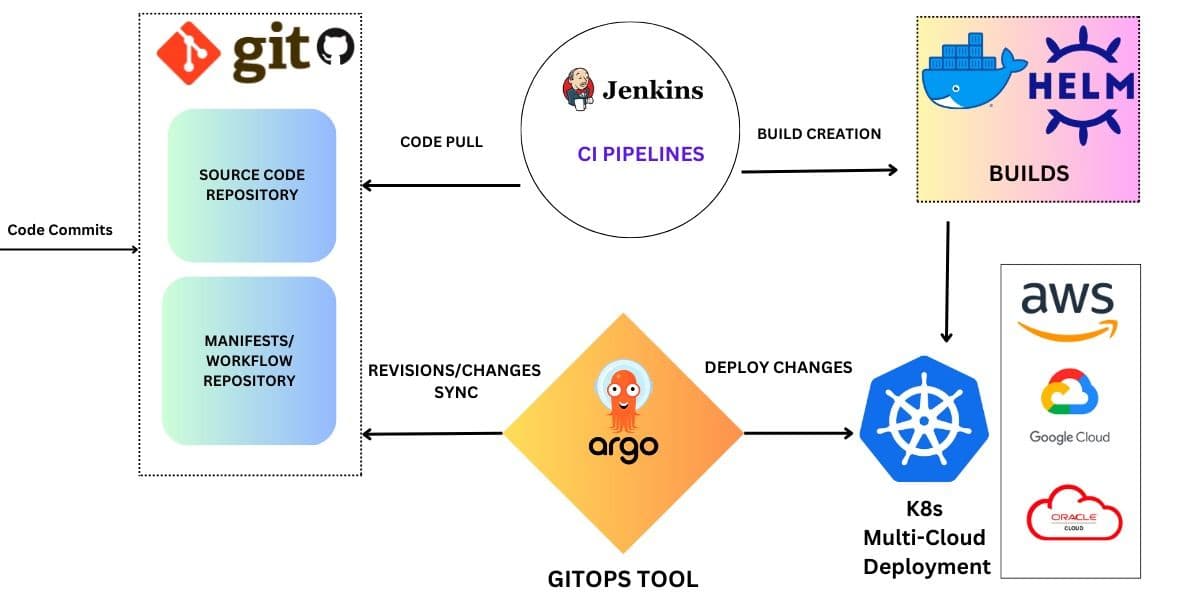
GitOps is an operational model that uses Git as the single source of truth for both application code and infrastructure configuration. Instead of pipelines pushing changes directly into environments, GitOps relies on automated agents that continuously monitor Git repositories and ensure the runtime environment matches what is defined in Git.
In GitOps, the desired state of the system is declared in version-controlled files. Any change to production must go through Git, usually via pull requests, reviews, and approvals. Once merged, GitOps controllers automatically reconcile the live system to match the declared state.
Core principles of GitOps
- Git is the single source of truth
- Declarative configuration defines desired state
- Automated reconciliation ensures consistency
- Pull-based deployments improve security
- Full auditability through Git history
GitOps is especially popular in Kubernetes-centric, cloud-native environments, where declarative configuration is the norm.
Core Differences Between GitOps and Traditional DevOps
The most fundamental difference lies in how changes are applied.
Traditional DevOps typically follows a push-based model. CI/CD pipelines actively deploy changes to environments. GitOps, on the other hand, follows a pull-based model, where agents running inside the infrastructure pull changes from Git and apply them.
Another key distinction is state management. Traditional DevOps often focuses on executing steps successfully, whereas GitOps focuses on ensuring the system always matches the desired state defined in Git.
GitOps also introduces stronger guarantees around traceability and reproducibility, while Traditional DevOps offers greater flexibility for diverse and legacy systems.
Benefits of GitOps
GitOps provides several advantages that align well with modern engineering requirements.
Single source of truth
Every change to infrastructure or application configuration is tracked in Git. This eliminates ambiguity and ensures everyone works from the same reference point.
Better auditability and compliance
Since all changes go through pull requests and commits, teams gain a complete audit trail. This is especially valuable for regulated industries.
Faster and safer rollbacks
Rolling back becomes as simple as reverting a Git commit. The system automatically reconciles to the previous known-good state.
Reduced configuration drift
GitOps controllers continuously monitor live systems and correct any drift from the declared state, even if changes occur accidentally or manually.
Improved security
Pull-based deployments reduce the need for external systems to have direct access to production environments.
Benefits of Traditional DevOps
Despite the rise of GitOps, Traditional DevOps remains extremely relevant.
Broad ecosystem compatibility
Traditional DevOps works across Kubernetes, VMs, bare metal servers, legacy systems, and hybrid environments.
Greater procedural control
Imperative scripts allow teams to handle complex, one-off tasks and edge cases that are difficult to express declaratively.
Lower initial learning curve
Most teams already use CI/CD pipelines. Enhancing existing pipelines is often easier than adopting an entirely new operational model.
Mature tooling and practices
Traditional DevOps benefits from years of tooling maturity, community knowledge, and enterprise adoption.
Challenges and Limitations
GitOps challenges
- Managing secrets securely requires additional tooling
- Repository structure can become complex at scale
- Strongly tied to declarative, cloud-native platforms
- Requires cultural discipline to avoid out-of-band changes
Traditional DevOps challenges
- Higher risk of configuration drift
- Weaker native audit trails
- Rollbacks can be complex and time-consuming
- Greater dependency on manual intervention in some workflows
Tooling Ecosystem Comparison
GitOps commonly uses specialized controllers that monitor Git repositories and apply changes automatically. These tools integrate tightly with Kubernetes and declarative configuration formats.
Traditional DevOps relies on CI/CD servers, infrastructure automation tools, and monitoring platforms. Pipelines orchestrate the entire lifecycle from code commit to deployment.
In practice, many organizations use a combination of both: CI pipelines for building and testing, and GitOps tools for deploying and maintaining runtime state.
Team and Organizational Impact
GitOps changes how teams think about operations. Developers interact primarily with Git rather than deployment tools or production environments. Operations teams focus on platform reliability rather than manual deployments.
Traditional DevOps emphasizes shared ownership and collaboration but allows more direct interaction with systems.
The success of either approach depends heavily on organizational culture, governance, and training. Without proper processes, even the best tools fail to deliver value.
When GitOps Works Best
GitOps is particularly effective when:
- You operate Kubernetes or cloud-native platforms
- You manage multiple environments or clusters
- You require strong governance and compliance
- You want self-service deployments without exposing production access
- You value automation and consistency over manual control
When Traditional DevOps Is Still the Right Choice
Traditional DevOps is often better when:
- You support legacy or non-Kubernetes workloads
- You require complex imperative workflows
- Your infrastructure spans diverse technologies
- Your team prefers incremental improvements over major process shifts
Hybrid DevOps and GitOps: The Real-World Approach
Most modern organizations do not choose one exclusively. Instead, they adopt a hybrid model:
- CI pipelines build, test, and package applications
- Git repositories store deployment manifests
- GitOps controllers deploy and maintain state
- Policies and approvals are enforced via Git
This approach combines the flexibility of Traditional DevOps with the reliability and auditability of GitOps.
Security and Compliance Considerations
GitOps naturally strengthens compliance by enforcing change control through Git workflows. However, teams must implement proper secret management and access controls.
Traditional DevOps can also be secure, but it relies more heavily on procedural discipline and tooling configuration.
In both models, security must be built into pipelines, repositories, and runtime environments rather than treated as an afterthought.
Final Verdict: Which Approach Works Better?
There is no universal winner.
- GitOps excels in cloud-native, Kubernetes-driven, compliance-focused environments
- Traditional DevOps excels in heterogeneous, legacy, or highly customized environments
- Hybrid models excel in most real-world organizations
GitOps does not replace DevOps. Instead, it refines and strengthens DevOps principles by using Git as the operational backbone.
Start learning today with Eduwise Solutions and prepare yourself for the future of modern engineering teams.