DevOps Periodic Table 2026: Your Visual Guide to Modern Software Delivery Tools
2/19/2026
In the rapidly evolving world of software development, speed, security, scalability, and automation are no longer optional — they are essential. As organizations increasingly adopt cloud-native technologies, CI/CD pipelines, AI-driven automation, and agile workflows, the need for a structured DevOps ecosystem has become more critical than ever. This is where the concept of the DevOps Periodic Table emerges as a powerful visual and strategic framework.
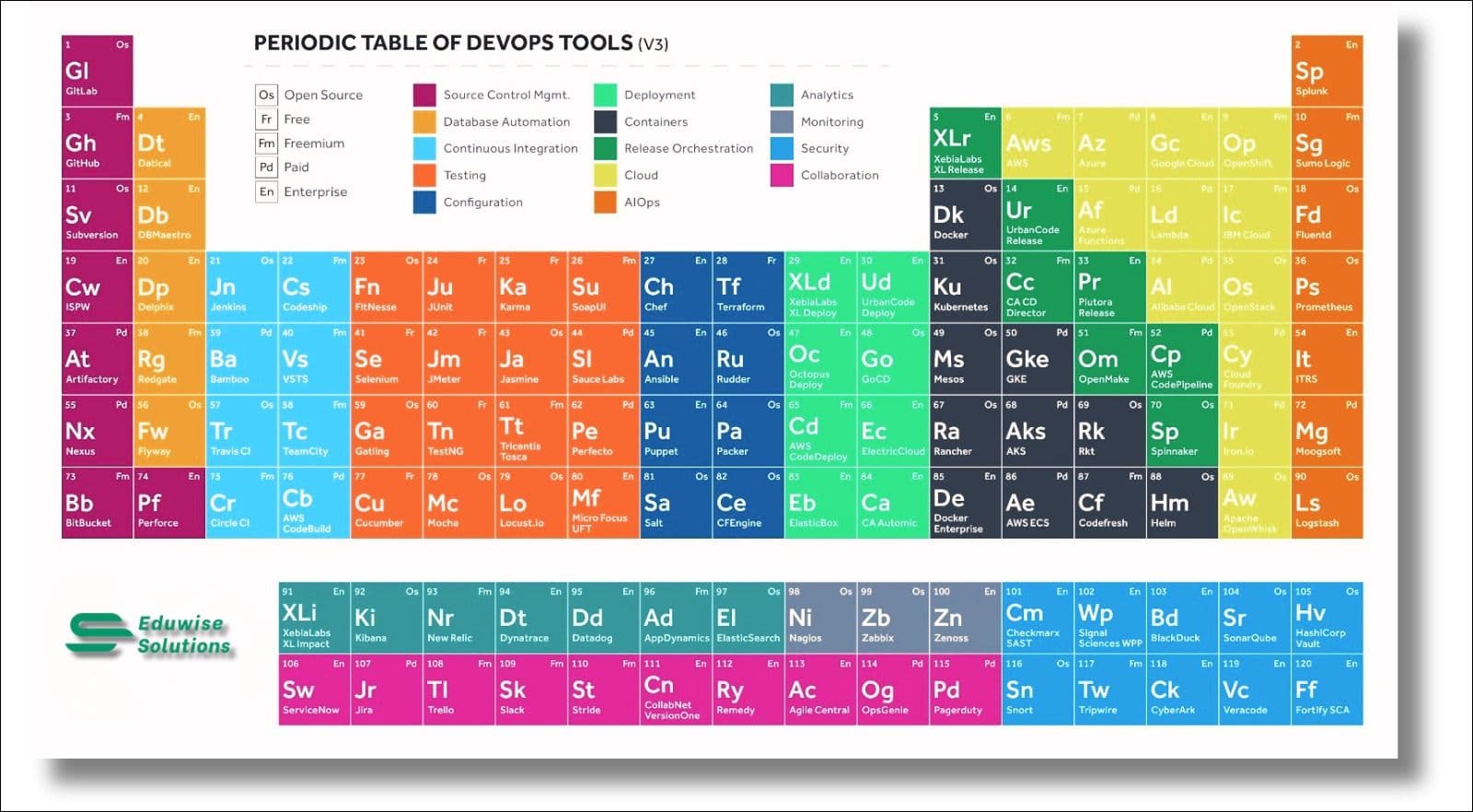
Inspired by the traditional chemical periodic table, the DevOps Periodic Table organizes tools, technologies, and practices into categorized blocks that represent different stages of the DevOps lifecycle. Instead of chemical elements, each block represents a DevOps tool, platform, or capability used across planning, development, testing, deployment, monitoring, and automation.
For organizations, developers, and aspiring DevOps engineers, the DevOps Periodic Table acts as a roadmap that simplifies complex toolchains into an easy-to-understand structure. It enables teams to visualize their entire software delivery pipeline, identify gaps, and implement a secure, automated, and scalable DevOps strategy.
At Eduwise Solutions, we emphasize practical DevOps learning through real-world toolchain mapping, and the DevOps Periodic Table serves as a foundational reference for building cloud-native and AI-powered DevOps pipelines.
What is the DevOps Periodic Table?
The DevOps Periodic Table is a structured visual framework that categorizes DevOps tools, platforms, and technologies based on their function within the Software Development Life Cycle (SDLC). Just like the chemical periodic table groups elements by properties, the DevOps Periodic Table groups tools by lifecycle stages such as:
- Planning & Collaboration
- Source Control
- Continuous Integration (CI)
- Continuous Delivery (CD)
- Testing & Quality Assurance
- Security & Compliance
- Containers & Orchestration
- Infrastructure as Code (IaC)
- Monitoring & Logging
- Cloud & Automation
Each "element" in the table represents a specific DevOps tool (e.g., Jenkins, Docker, Kubernetes, GitHub, Terraform) that plays a critical role in automating and streamlining the software delivery pipeline.
This framework helps organizations transition from traditional IT operations to modern DevOps culture with automation, collaboration, and continuous feedback loops.
Why the DevOps Periodic Table Matters in 2026
The DevOps landscape in 2026 is driven by Cloud Computing, AI Automation, and Platform Engineering. Companies are no longer relying on isolated tools — they are adopting integrated DevOps ecosystems.
Here's why the DevOps Periodic Table has become a strategic necessity:
1. Simplifies Complex DevOps Toolchains
Modern DevOps environments include dozens of tools. The periodic table organizes them into clear categories, making adoption easier.
2. Enables Faster Digital Transformation
Organizations can quickly design scalable pipelines by selecting tools from each category.
3. Supports Cloud-Native Development
With the rise of AWS, Azure, GCP, and Kubernetes, structured tool mapping improves deployment efficiency.
4. Promotes DevOps Culture and Collaboration
It bridges the gap between Development, Operations, and Security teams through a unified visual framework.
5. Enhances Learning and Training
For students and professionals, it serves as a comprehensive learning blueprint — a methodology actively used in Eduwise Solutions' industry-aligned DevOps training programs.
Structure of the DevOps Periodic Table Explained
The DevOps Periodic Table is divided into multiple color-coded and functional sections. Each section represents a key domain of the DevOps lifecycle.
1. Planning & Project Management Layer
This layer includes tools used for sprint planning, backlog tracking, and agile management.
Common Tools:
- Jira
- Trello
- Azure Boards
- ClickUp
These tools ensure visibility, accountability, and streamlined project execution from the initial phase.
2. Source Control & Version Management
Version control is the backbone of DevOps workflows. It allows teams to collaborate efficiently and track code changes.
Key Tools in This Section:
- GitHub
- GitLab
- Bitbucket
Version control systems integrate seamlessly with CI/CD pipelines and enable automated workflows.
CI/CD Tools in the DevOps Periodic Table
Continuous Integration and Continuous Deployment (CI/CD) form the core of DevOps automation. This section of the periodic table typically includes:
- Jenkins
- GitLab CI/CD
- CircleCI
- Azure DevOps Pipelines
- Bamboo
CI/CD tools automate:
- Code building
- Testing
- Deployment
- Release management
By integrating CI/CD tools, organizations achieve faster delivery cycles and reduced manual errors.
At Eduwise Solutions, learners are trained on real-time CI/CD pipelines to prepare them for enterprise DevOps environments.
Infrastructure as Code (IaC): The Automation Backbone
Infrastructure as Code tools are critical elements in the DevOps Periodic Table. They allow teams to provision and manage infrastructure using code instead of manual configuration.
Popular IaC Tools:
- Terraform
- AWS CloudFormation
- Pulumi
- Ansible
Benefits of IaC:
- Consistency in infrastructure deployment
- Reduced configuration drift
- Faster provisioning
- Scalable cloud environments
This category is essential for organizations adopting multi-cloud and hybrid cloud strategies.
Containers & Orchestration Layer
Modern DevOps pipelines rely heavily on containerization and orchestration technologies.
Key Tools in This Section:
- Docker
- Kubernetes
- Helm
- OpenShift
Containers ensure application portability, while orchestration platforms automate scaling, load balancing, and deployment management.
The DevOps Periodic Table highlights containers as a central pillar of cloud-native architecture.
Cloud Platforms in the DevOps Ecosystem
Cloud computing plays a dominant role in the DevOps Periodic Table. Cloud platforms provide scalable infrastructure, automation tools, and AI-powered services.
Major Cloud Platforms:
- AWS (Amazon Web Services)
- Microsoft Azure
- Google Cloud Platform (GCP)
Cloud integration enables:
- Auto-scaling applications
- Serverless deployment
- Global infrastructure management
- High availability systems
Eduwise Solutions integrates Cloud + DevOps + AI training modules to align learners with real industry requirements.
Testing & Quality Assurance Tools
Testing is a critical stage in the DevOps lifecycle. The periodic table includes multiple testing categories such as:
- Unit Testing (JUnit, NUnit)
- Automation Testing (Selenium, Cypress)
- API Testing (Postman)
- Performance Testing (JMeter)
Automated testing ensures:
- Faster bug detection
- Improved code quality
- Reduced production failures
Shift-left testing strategies are now a standard practice in modern DevOps pipelines.
Monitoring, Logging & Observability Tools
After deployment, continuous monitoring is essential for performance optimization and incident detection.
Key Monitoring Tools:
- Prometheus
- Grafana
- ELK Stack (Elasticsearch, Logstash, Kibana)
- Datadog
- New Relic
These tools help organizations:
- Track system health
- Detect anomalies
- Analyze logs in real-time
- Improve system reliability
The DevOps Periodic Table emphasizes observability as a core lifecycle component.
Security Integration in the DevOps Periodic Table (DevSecOps Perspective)
Although the focus is DevOps, modern pipelines integrate security at every stage. Security tools in the periodic table include:
- Snyk
- SonarQube
- OWASP ZAP
- Checkov
- HashiCorp Vault
Security integration ensures:
- Secure code scanning
- Vulnerability detection
- Secrets management
- Compliance enforcement
This approach supports the "Shift Left Security" model widely adopted in enterprise DevOps environments.
AI & Automation: The Future of the DevOps Periodic Table
Artificial Intelligence is redefining the DevOps ecosystem. AI-powered DevOps (AIOps) tools are now becoming key elements in the periodic table.
AI in DevOps enables:
- Predictive analytics
- Automated incident response
- Intelligent monitoring
- Smart CI/CD optimization
Eduwise Solutions focuses on Cloud AI + DevOps integration to prepare professionals for next-generation DevOps roles.
How Organizations Use the DevOps Periodic Table
1. DevOps Pipeline Design
Teams use the table to design end-to-end automated pipelines.
2. Tool Selection Strategy
Helps compare and evaluate tools across categories.
3. Gap Analysis
Identifies missing components in existing DevOps workflows.
4. DevOps Maturity Assessment
Organizations measure their DevOps readiness using structured tool mapping.
5. Training & Skill Development
Educational institutions and training providers use it as a learning framework — a methodology strongly aligned with Eduwise Solutions' industry-driven curriculum.
DevOps Periodic Table for Beginners: A Learning Roadmap
For beginners, the DevOps Periodic Table acts as a step-by-step learning guide:
- Learn Linux & Networking
- Master Git & Version Control
- Understand CI/CD Pipelines
- Learn Docker & Kubernetes
- Explore Cloud Platforms
- Implement Monitoring & Automation
This structured roadmap accelerates career growth in DevOps engineering.
Benefits of Using the DevOps Periodic Table
- Clear visualization of the DevOps ecosystem
- Faster tool adoption
- Improved team collaboration
- Enhanced automation strategy
- Scalable cloud infrastructure planning
- Better security integration
- Streamlined CI/CD workflows
For businesses, it reduces operational complexity and increases deployment efficiency.
DevOps Periodic Table vs Traditional DevOps Approach
| Traditional DevOps | DevOps Periodic Table Approach |
| Tool confusion | Structured categorization |
| Reactive planning | Strategic roadmap |
| Manual integrations | Automated ecosystem |
| Limited visibility | End-to-end lifecycle view |
The periodic table transforms DevOps from a toolset into a strategic framework.
Role of Eduwise Solutions in Modern DevOps Learning
As industries rapidly shift toward automation, cloud-native development, and AI-powered deployment, the demand for skilled DevOps professionals is at an all-time high. Eduwise Solutions bridges this skill gap by offering industry-focused DevOps training aligned with real-world toolchains represented in the DevOps Periodic Table.
Key Differentiators:
- Industry-expert mentorship
- Hands-on CI/CD pipeline projects
- Cloud + AI integrated DevOps curriculum
- Real-time toolchain exposure
- Placement-oriented training approach
This practical ecosystem ensures learners gain job-ready DevOps skills rather than just theoretical knowledge.
Future Trends Shaping the DevOps Periodic Table (2026–2030)
1. AI-Driven DevOps (AIOps)
Automation powered by machine learning will optimize pipelines.
2. GitOps Adoption
Git-based deployment workflows will dominate cloud-native environments.
3. Platform Engineering Growth
Internal developer platforms will streamline DevOps operations.
4. Cloud-Native Security
Security-first DevOps will become the industry standard.
5. Hyperautomation
End-to-end automation across development, testing, deployment, and monitoring.
Eduwise Solutions continuously updates its DevOps training modules to match these evolving industry trends.
Conclusion: Why the DevOps Periodic Table is a Game-Changer
The DevOps Periodic Table is more than just a visual infographic — it is a strategic blueprint for modern software development. It simplifies complex DevOps ecosystems, enhances collaboration, accelerates automation, and integrates cloud, AI, and security into a unified lifecycle.
From planning and coding to deployment and monitoring, every stage of the SDLC is represented through categorized tools and platforms. For organizations, it serves as a roadmap for digital transformation. For learners and professionals, it acts as a comprehensive DevOps career guide.
In a world where speed, scalability, and security define success, adopting a structured DevOps framework is no longer optional — it is essential.
Learn DevOps Periodic Table with Cloud AI & Placement Support
Ready to master the complete DevOps ecosystem and build real-world pipelines using industry tools mapped in the DevOps Periodic Table?
At Eduwise Solutions, we provide:
- DevOps + Cloud Computing
- AI-Powered Automation
- Real-Time Projects
- CI/CD Pipeline Implementation
- Kubernetes & Docker Hands-On
- Placement Support with Career Guidance
Whether you are a student, fresher, or working professional, our structured learning approach helps you gain practical DevOps skills aligned with current industry demands.
Empower your future with automation, scalability, and next-generation DevOps expertise.